Months after Catalina and Dima went south, the Collective is running copper north out of Sidliste. Raduj works the survey: poles counted, insulators carried, a tester signed out of Depot 2 and due back on the twenty fourth. He is from the Collective and means to leave it, and with the line he intends to keep contact with his friends after he leaves.
Chapter one, the shore road
Near the concrete coast #
Months after Catalina and Dima went south, the Collective has pushed a telephone line west out of Sidliste toward the water. Raduj walks the shore road with a shouldered pack carrying insulators, a hand crank tester and a roll of marking tape, counting poles against a survey sheet.
The rain stopped a few minutes ago and the gravel is still soaked with water. Across the channel the island sits under low cloud, its treeline grey at that distance.
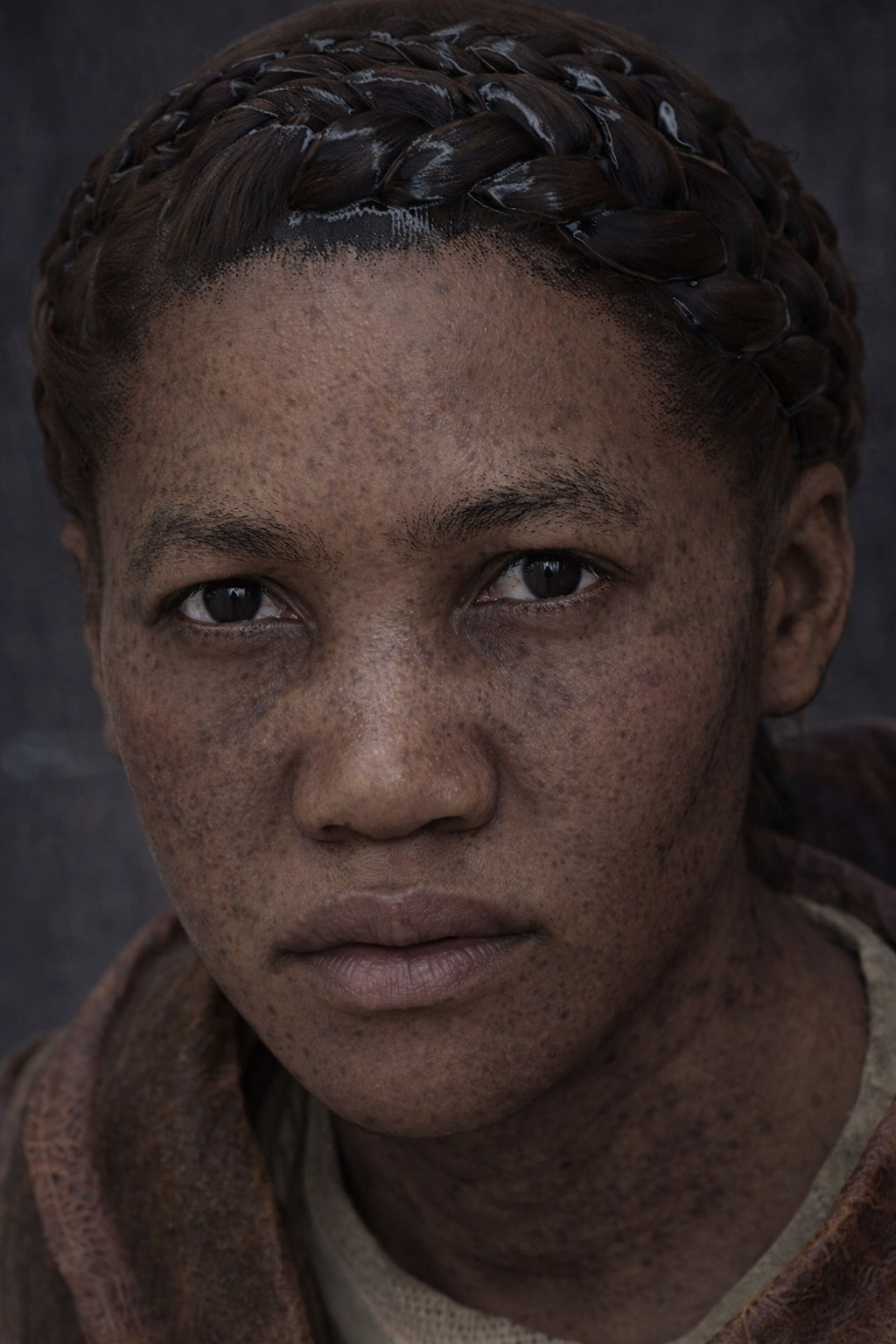
About twenty metres ahead a woman stands near the concrete coast, a pickaxe held low in one hand and a bundle tied in cloth across her back. She is taller than Raduj and has wide shoulders and arms. Her hair is in a crown braid, and her robe hangs dark with rain down one side. Freckles cover her cheeks and nose, and the skin across both cheekbones is smooth. She turns her head and watches him.
approaching and waving a hand casually Hey, how are you doing?
shifts her grip once on the pickaxe handle, looking down at the gravel You came up the road alone.
I am from the Collective. I want to leave that place but since I have friends in there I wanted to work as a telephone line surveyor and establish a way to still be able to talk to each other.
I have heard about that from people who came back across the water, and I did not believe most of them. You walk this road every day?
This is my first time here.
Then you picked a bad stretch. The shore bends north from here and the water gets close to the road, and there are two houses further up with people living in them who watch it.
What's your name?
Nila. lifts the pickaxe and rests it head down, one hand on the shaft And I am not going back across, so keep walking or you can say yours.
extending a hand Raduj.
takes his hand and shakes it hard Raduj. You are the first person who has put a hand out instead of reaching for something.
feeling her hand shaking hard You're really strong.
You are average. Everyone out here is, and everyone on the island is.
A clean face #
pointing at her cheeks You don't have the cuts.
touches one cheekbone with two fingers and lets the hand drop My ceremony was postponed. They keep postponing them since your Collective went up and people started walking off the island at night. The elders decided that cutting a hundred faces in one season would empty the place faster. I fought two full seasons with a clean face and no one said a word about it to me, because the ones who look at the cheeks first are the ones who have never stood next to me in a fight.
I heard that Seraphites often don't care about their lives and don't shout.
We are taught the body is borrowed and goes back when it goes back, so a hurt Seraphite keeps coming. I have seen a woman with a hole through her side walk the last ten metres to a wolf and put an axe in him, and I have seen men on the ground with a broken arm reach for a knife with the other hand instead of calling for help.
We were taught that the body is a biological support for the mind, and that without the body, the mind cannot survive. We are also taught to assume good intention. Why didn't you punch me and put an axe?
Because there was no reason to. You came up the road with paper in your hand and your hands out where I could see them, and you asked my name. I have swung this at people who were running at me and I will swing it again if someone runs at me, and standing here with you I just do not feel like it.
pointing at her hair Your face is dry but your crown isn't.
pulls the front of the braid with two fingers slightly It holds the water. Takes until night to dry out, and in winter it never does, so you sleep with a wet head or you take it apart. I have been thinking about taking it apart.
Why don't you take it apart now?
Because it is wet. Mine is braided tighter than most, so the strands hold onto each other when the water is in them, and pulling at it now would take an hour and leave half of it knotted at the back where I cannot see. I would need it dry, and I would need both hands free, and I would need somewhere to sit that is out of the rain.
pointing at a bench We can sit there or walk, if you want to.
looks at the bench, then at the road going north Walk. I have been standing here since the rain started and my feet have gone cold in these boots, and I would rather be moving while I talk to you.
The ferry dock #
starting to walk north Alright. So, what made you leave the island?
lifts the pickaxe onto her shoulder and falls in beside him, matching his pace after a few steps Three of us went out to bring back a family that had run, a mother and two boys, and the order was to bring them back alive. We found them in a house by the ferry dock and the other two killed the mother in front of the boys, and then we walked the boys home and there was no punishment. I carried one of those boys most of the way because he had stopped walking on his own. I put him down at the gate and I went to my bed, and I lay there working out how many times I had told myself that the next one would be different.
And then you simply could not tolerate the abuse anymore.
The abuse I could take as I took it for years and I would have taken more of it. What I could not take was the story they put on top of it, because the mother was running with two children and that was the whole of what she did, and there was nothing in it that could be named and called a sin. She did not deserve to die, and the two who killed her went back and ate and slept and said the words at the end of the day like the rest of us.
The evening words #
What did they say?
keeps walking, eyes on the road ahead You give thanks for the body you were lent that day, you name what you took from the world and what you gave back to it, and you ask the Prophet to keep you calm. That last part is said aloud together. Of the thirty people saying may she keep me calm, two of them had washed a woman's blood off their hands an hour before.
How can she keep calm if they created tension by killing?
They say the calm is in the one who does the work, that the hand stays steady and the mind stays quiet while the body does what it was lent out to do, and the tension belongs to the one who ran.
So, it's outsourcing responsibility.
I do not know that word, but if it means the killing lands on the one who got killed, then yes. I asked an elder once where the mother's calm went.
And what did they say?
He told me to fetch water. He was holding a cup that was already full, and he waited until I came back with the bucket, and then he sent me to the kitchens for the rest of the evening so I would have something to do with my hands.
So, he didn't give any answer.
No. The elders give you work when they want a question to stop, and after a while everyone learns which questions get you sent to the kitchens. I knew before I opened my mouth that he would do it and I asked anyway.
That's so unfair. Usually I don't comment on things, but this is my true opinion.
glances at him, then back at the road It is. You are the second person to say that to me out loud and the first one was me, in my head, walking to the water with this on my shoulder.
I place great value in life. I would rather choose a life that is long despite having limited freedom than one that is short but has all freedom in the world. The Collective started to reduce working hours after so many fights.
Mine was neither. I had the hours they gave me, and the women who went out with me two seasons ago are mostly dead now, so I was counting on maybe four more years. Tell me about the hours.
Chapter two, the line
A road for messages #
I work in what they call Information Technology, a relatively new field. Some people were sent out to retrieve all kinds of old computers that are still functional, test them, and write scripts that do calculation. I have been assigned to a workstation that had KDE 3 on it according to the interface. And I wrote interfaces for remote machines, so rather than operating the machines ourselves, we would operate the machines at a distance.
I have seen computers. An elder made a pile of them in the yard when I was small and burned it while we stood around watching, and he talked the whole time about what the old world did with them. He never said what they were for, so I only know the shape of the thing and the smell of it burning.
Computers are devices that process massive amounts of information at once. They have many functions, like storing information without occupying physical space, modifying information with ease, deleting without having to physically discard the thing. It can also run instructions automatically, which makes work that would normally be manual and slow faster and effortless. It can also be used to transmit information without having to physically deliver letters.
slows a little, looking at the poles running along the road Then what are the wires doing? You said you are putting a line out here so your friends can talk to you, and if the machine does the work in one place, I do not see why any of it has to come down a road and out to the water.
Well, it's because machines cannot communicate at distance via radio. It would be too inefficient, and at far distances, the message would either be distorted or dropped. So, using imported technology from Europe, we build wires and towers that transport information.
So it is a road you put down once and then the messages walk it instead of a person.
pulling out a communicator This is a communicator. Here you can see I have some texts from work and no calls because friends were close by. There is no signal.
- LINE OFFICE / SIDLISTE MON 16:22 Pole count for segment 7 before Friday. Tester serial must be on the sheet this time.
- LINE OFFICE / SIDLISTE MON 09:41 Insulator crate short by twelve. Do not set any pole past the bend until resupply.
- STORES / DEPOT 2 SUN 18:07 Tape and tester signed out to R. Your return date is the 24th.
No entries
stops walking and looks at it It is lit from inside. Which part of that is the writing and which part is the machine talking to you?
clicks on the first message Humans write the messages, the machine only displays the interface.
Pole count for segment 7 before Friday. Tester serial must be on the sheet this time. The clerk sent back your last sheet because the field was blank and he will send back this one too. Write the serial.
If the bend floods again, mark it and come back. Do not wade it alone.
One is worried about you wading a flood on your own, and one is angry about one empty line on a piece of paper.
Yes. Now if I reply, it will try to dial up and of course it will fail. pressing REPLY and then typing a reply in the box
Serial is T-4471. It is on the sheet now. Segment 7 counted to pole 34, the rest after the bend. The bend is wet and I have left it.
Message held in outbox.
Retry when a line is present.
It kept the words. So the thing is sitting there holding a sentence for a road that is only half built, and it will hold it until you walk far enough back that the road starts again.
pressing OUTBOX Yes.
- LINE OFFICE / SIDLISTE HELD / NO CARRIER MON 19:06 Serial is T-4471. It is on the sheet now. Segment 7 counted to pole 34, the rest after the bend. The bend is wet and I have left it.
looks up the road north, then back at him How far do you have to walk before it goes?
I have to go back to a kilometer or so from Sidliste.
That is where I am going. Not tonight, though. I would want a roof and fire before I walk up to the gate and ask people to take me in.
There is a cleared apartment besides the last pole I counted. We can rest there.
shifts the pickaxe to the other shoulder Show me. If it has a door that shuts I will sleep on the floor of it and be glad.
pointing to a curve Two intersections after that curve.
The gate, the tin and the well #
starts walking again, a little ahead of him now Tell me what happens at the gate when somebody like me comes up to it.
also starts to walk again, aligning to her They take the axe and accept you as a refugee.
They take it and then what, it sits in a room somewhere with a number on it?
It goes in customs and then they give it back to you once fully processed. This is to prevent you from attacking from the inside.
So I would get it back.
Yes, but you will not be allowed to use it on the street.
That is fine. I would put it under a bed and leave it there, since carrying it on a street where no one else is carrying one would only make people look at me, and I have had enough of being looked at this week.
noticing her put a hand on her stomach Do you feel alright?
Yes. takes the hand off her stomach I ate the last of what I had yesterday morning and it has been sitting empty since, that is all.
I can see you are not fine. You are leaning.
straightens up and the pickaxe comes down off her shoulder to hang at her side All right, yes. I am a little sick with it. What I ate yesterday came out of a tin I found in the ferry office and the seam on it was bad.
Vomit if you need to. Don't keep it.
moves off the road to the grass at the edge, sets the pickaxe down, and stands with both hands on her knees for a while before anything happens Give me a minute. It has been coming and going since the rain started.
waiting for a bit Alright.
vomits into the grass twice, spits, then stays bent over with her hands on her knees and breathes That is better. wipes her mouth on the back of her wrist and straightens slowly I have water but it is river water and I have been rationing it.
You must be careful on what you eat. Sometimes eating is worse than not eating at all.
I did not think of it that way. On the island you eat what is put down and you eat it fast, and a bad tin was something you got through and then worked anyway.
Your stomach ejects the contents of the tin. They will not be processed, therefore, your hunger will not be satisfied.
So I am where I started, minus the water I have lost bringing it back up.
Yeah. giving a metal bottle from his pack Drink from this.
takes the bottle, looks at the mouth of it, then drinks three long swallows That is clean. Where did you fill it?
We managed to create a public water system where we filter out both the rain and water from the sewers.
lowers the bottle slightly From the sewers and people drink it without getting sick.
Yes, and there are particulate tests. We plan to automate particulate tests, so we can get the contents of the water right now without waiting a week for the determinant solutions to materialize.
holds it out to give back So right now somebody is drinking water that was tested before they drank it, and the answer about that water comes back seven days after it went down their throat.
taking the bottle back and putting it back in his pack No, the water is drank after the test results come.
So there is a week of water standing somewhere, waiting to be told if it's clean. That is a lot of water to be holding onto.
Yes, and every time a new source of water is discovered, it has to undergo the same procedure. And the existing sources are continuously tested.
starts walking again On the island the water came out of two wells and a rain catch and no one tested anything, and when people got sick from it the elders said the sickness was in the person.
also starting to walk alongside her again The sickness is not in the person. Bacteria grow in stale waters. The sewers are the worst due to mycelium, that is, fungus, and other particulates. When you drink that water, all the particulates, fungi and bacteria go into you and they leave stomach and spread to other parts of the body and you get sick.
For us everything was guilt, yours or the village's, and the sickness was what came of it. But the well took people who prayed and people who did not, children who had done nothing at all, and an elder went the same way as the rest, so that should have been the cause.
Small organisms #
Yes, other living organisms, not spirits.
How small are they, these organisms? Small like a seed, or small like dust?
They are even smaller than dust. A dust particle is anywhere between zero point one to ten microns, however, most particles are ten microns. A bacteria is one micron, a virus can be nanometers small because it is formed of simple protein structures that encode a genetic code that contains instructions a host needs to execute to create copies of the virus.
keeps walking and says nothing for a few steps So there is a thing too small to see that carries instructions, and it gets into a person and the person builds more of it without knowing.
Yes. The infection appears only when there are millions or billions of copies.
Millions. stops at the edge of the road where a drain runs out of the grass and looks at the water coming from it And by the time the person feels it, the counting is already done and they are only finding out late.
No. The virus continues to multiply indefinitely until the immune system arrives to kill all the particles and cells that contain the code.
What is the immune system? You are saying it as though I would know the word, and I am telling you now that I do not, so say it the way you said the wires.
The immune system is a system of cells inside the body that is designed specifically to defend you against those small particles and bacteria. When a foreign particle, that is, a particle that is not part of your body, it gets absorbed by the mucosa, the substance in your nose. When multiple particles enter the body through any pathway like cuts, mouth, nose or whatever opening, specialized cells recognize the particles, and send macrophages and B cells. B cells produce antibodies that attach to the particles, so they are even easier to identify and transport to macrophages, which absorb and destroy the threats.
looks at the drain water again So the body has people in it. Ones that find the thing, ones that mark it so it can be found faster, and ones that eat it. And all of that happens whether or not anyone prays over you.
starting to walk again after having looked at the water Of course, except that those people are cells in your blood, commonly known as white blood cells.
falls back into step beside him I have seen enough blood to know it is all red, so where are the white ones?
The white ones form a smaller proportion of your, my or anyone's blood and they are mixed into it. The vast majority of blood is formed of hemoglobin that transports oxygen.
So the red is the carrying and the white is the fighting, and there is more carrying than fighting. glances at him You know this the way I know how to set a snare.
Grades, and a boy called Biliboaca #
Yes, it's the biology one ou one course, which is mandatory.
Everybody gets taught that? Children as well, or grown people who come in from outside?
Yes, but primarily children.
And someone like me, twenty-six and coming through the gate with an axe. Would they put me in a room with the children, or is there something else for people who arrive late?
There is, you can go to university to learn an expanded version of the course.
shifting the pickaxe again How hard is that to follow? I can read, but slowly, and it is mostly names and lists of provisions and the writing on the boards in the hall. I have never read a page of anything that was trying to teach me something.
It's not complicated, they say it ranges anywhere from sixth grade to eight grade, which means a fourteen or fifteen year old can understand it.
I have no idea what a grade is. Tell me what a person that age can do with a page, and I will tell you whether I can do it.
Okay, so, in the Collective's education system, children have ten grades, or eleven if we include the preparatory. Every child has to go to school at the age of six or in some cases seven if there are additional deficiencies.
At the preparatory grade you learn to read basic sentences and count from one to five. At the first grade, you learn how to read short phrases and count from one to ten. At second grade you learn how to write by hand and fourth you should be proficient at that.
And then, the fifth grade starts with the full extent of arithmetic and geometry, without complex problems or calculus, which is studied at university. You also get to read long-form artistic and scientific text, and you learn the basics of various subject matters that are required for informed decision-making.
By eight grade, you should understand all basics, most of the English language, or Czech, or Polish, or whatever language you came with. By eight grade you will be fourteen, fifteen or sixteen years old.
walks a while before answering Then I am somewhere near the second, by your counting. I write my name and I write numbers and lists, and that is the whole of it.
Not necessarily. At second grade you are expected to fully understand the text Biliboaca. pulling out the communicator and searching the files application for the text
- READERS/BILIBOACA.FTXT 4 KB G2
- READERS/BILIBOACA_QUESTIONS.FTXT 1 KB G2
leans over to look at the screen and stops walking to do it Open the first one. Read it out first and then let me try, because if I take it straight from a lit screen in front of somebody I will go slower than I do on paper.
opening the text Well, here it is.
Biliboaca
Biliboaca walks home from school. He walks slow. He kicks the dead leaves on the path.
Today he got a four in arithmetic. The signs on the board were strange to him. He looked at the ceiling. The teacher said, we will talk next time.
In the yard there was a fight. Biliboaca gave many hits. He got one hit, on the nose. The nurse gave him a cloth. Everyone told him to hold his head up.
At the gate he dropped a paper. A woman told him to pick it up. He picked up his paper. She told him to pick up the other ones too. He picked up two. Then he ran.
Chirica told him later, that woman was the inspector.
At home the rooms are empty. The soup is warm on the stove. Biliboaca is hungry. He takes a big bite. It is the hot pepper.
Then his mother comes in and asks him, what was at school today?
Biliboaca says, nothing.
stops to look at the screen after he stops reading The last line I got on my own. He had a whole day of it and he handed her one word. straightens up What is a four?
In the grading system that the text implies and the Collective uses, grades are anywhere from one to ten, and four is a grade below passing, at six. When you obtain enough low grades, you need to move to a school designed specifically for people who do not understand the matter in question and pass a "corigentia" or "propadazica", simple test where if you obtain at least six, you pass and go back to normal school, and if you don't, you advance the next grade in the special school.
So the boy is sitting there knowing a number and knowing what the number means for the next year of his life, and then his mother asks and he says nothing. starts walking again I would have said nothing too.
exits the text file and opens the questions file And now the questions.
Biliboaca, questions
1. Where is Biliboaca walking at the start?
2. Write the three things that went wrong at school.
3. Why does the woman tell him to pick up the other papers?
4. Who was the woman?
5. What does Biliboaca eat by mistake?
6. His mother asks what was at school today. Write what you think he should have said to her, in two sentences.
The first five I can do out loud right now. The last one wants me to write two sentences about what a boy should say to his mother, and I would sit in front of that for an hour.
Tags, limits and refused lines #
exits the file and goes into the PISA directory Ow, let's try PISA maybe.
- PISA_READING_2000_GRAFFITI.FTXT 6 KB L2
- PISA_READING_2000_LAKE_CHAD.FTXT 5 KB L3
- PISA_READING_2003_GIFT.FTXT 14 KB L5
- PISA_SCIENCE_2006_SUNSCREENS.FTXT 9 KB L4
- PISA_MATH_2003_WALKING.FTXT 4 KB L4
- PISA_ADMIN_SCORING_NOTES.FTXT 2 KB -
reads the list slowly, moving her lips on the longer words What are the letters and numbers at the end of each one?
They are the file sizes and the alternate data stream. The alternate data stream is displayed after the size and offers additional information. exits the application, opens help, and navigates to the file application help There is a help application in here.
A listing line shows three columns.
The tag is held in a second stream attached to the file. The card in this unit is formatted MRFS-32, a Meridian variant of FAT32 with a stream table added in the reserved area. The file itself is unchanged, so the tag adds nothing to the size shown.
Note: streams survive a copy between two MRFS-32 cards and between MRFS-32 and NTFS, where they are written as alternate data streams. A copy onto EXT4 or onto plain FAT32 writes the file alone and the tag is dropped without warning.
FTXT is Meridian formatted text. The body is plain text. The unit sets the layout from the header and from the shape of the lines.
The header is a stream, not part of the body. An editor that reads bytes alone opens the body without it. On EXT4 or plain FAT32 the stream is dropped and the file becomes plain text.
Header:
Body:
A block that does not resolve is shown as typed. A page longer than the screen scrolls. A file with no page list is one page. This is a partial table of the applied formatting changes, more elements are shown on the FTXT documentation.
So the tag is written somewhere beside the file and it costs nothing, and it comes off if you put it down in the wrong place. looks up from the screen at the road How far now?
We are close, it was actually three intersections away and they are so far considering the shrubbery. turning the page to limitations
MRFS-32 is the on-card format of this unit. It was designed around the dial link, so a held message, its attachments and its tags can be written and sent in one pass.
Limits on the card:
Reading is paged from the card, so a file of any size can be opened. The editor loads a whole file into the buffer, so a file above 64 KB opens read only and the edit key is refused.
Small files still take a whole cluster, so an archive of short readers on a 2 GB card will report more space used than the sizes add up to.
Lowercase is stored and can be shown by loading a second font and turning off the display filter. The filter is part of the firmware and turning it off is an unsupported operation.
On a computer:
The unit connects as an MTP device. MTP moves whole files only. A file opened from the unit is copied to the computer first and written back whole on save, so editing in place and seeking inside a large file are unavailable over the cable.
Windows shows the unit under portable devices and reads tags as alternate data streams. Tags are read only there.
Linux mounts the unit through libmtp or mtpfs. Tags are invisible under both. A file copied off and back returns without its tags and with a new timestamp. Mtpfs also reports free space from the last session, so a full card can still look empty.
Tags are written and edited on the unit: Files > Open > Tag > Edit.
For a card read directly in a card slot, use the Meridian Card Tool. A card written by any other tool loses the stream table and the unit will ask to format it.
points with two fingers at the last lines without touching the glass All of that is about what happens to the writing when it moves between machines. Somebody sat down and worked out every way it could go wrong and then wrote it out for a stranger.
Back in the 2000s, yes. Meridian wrote everything out despite being proprietary so you didn't have to call them out. turning to the security page The device also knows what is a fork bomb.
This unit has no virus scanner. The shell parser refuses a small list of written forms before the line runs. A refused line prints
and the script stops at that line.
Self-replicating calls:
Writing that fills the card:
Destructive paths:
Remote and hidden execution:
The list is fixed in firmware and cannot be added to or turned off.
stops reading partway and looks at him You have a thing that argues with you about what you are allowed to type into it.
turning to shell specification page It does not argue, it simply blocks the specified commands which can be found in the physical documentation.
Supported:
Absent:
Limits:
The parser reads the whole line before running it and compares it against the refused forms listed under Shell / refused patterns. The full list with examples is in the printed manual, section 9, supplied with the unit.
Chapter three, the block
The jacket #
Past the curve they leave the shore road and walk inland, and after the third intersection a low block of flats comes up behind the shrubs on the left, four storeys, most of the windows dark and two on the ground floor boarded from inside.
Is that it, the one with the dark windows?
heading towards the block That is it.
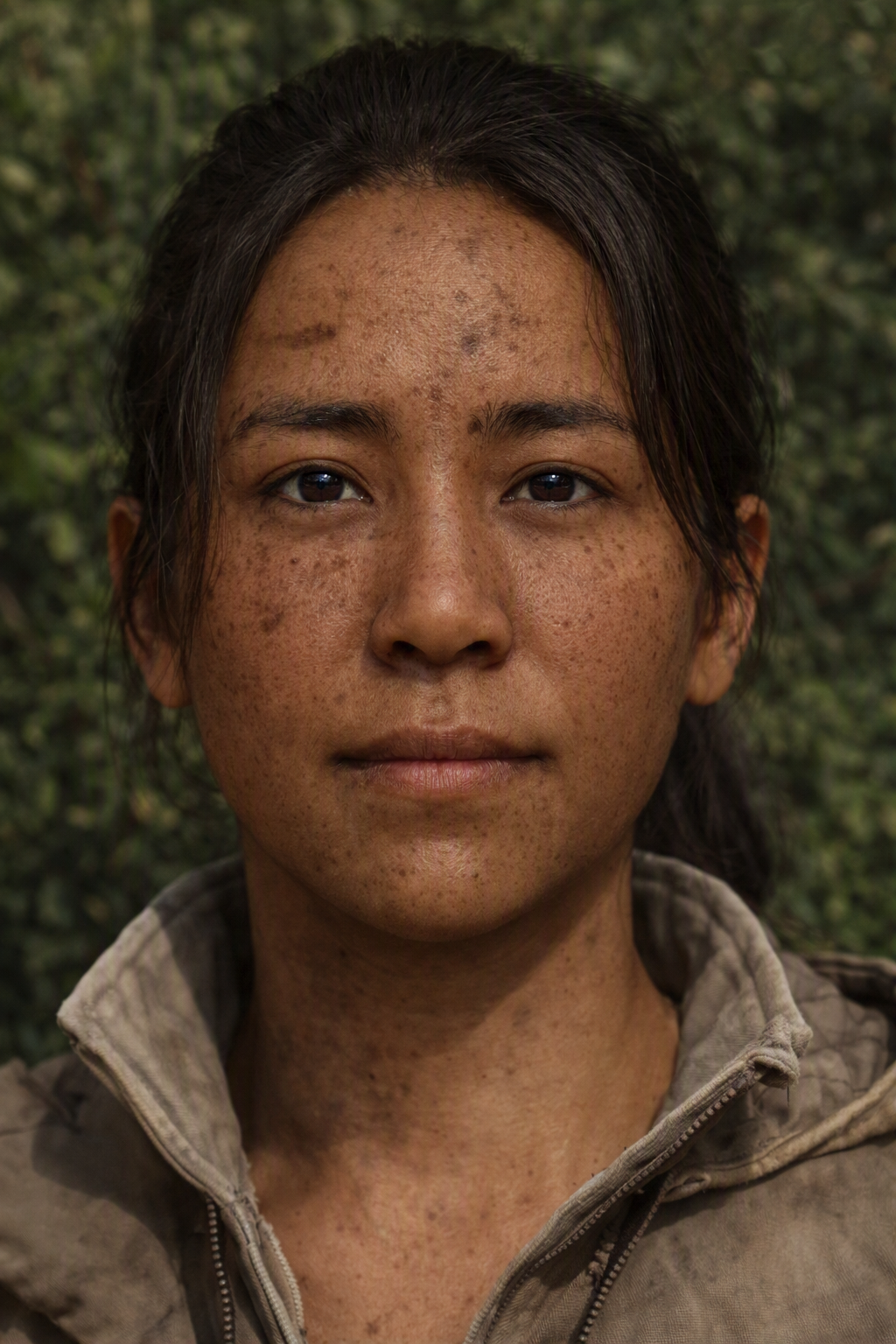
The entrance door stands half open. A woman steps out of it with a bucket in one hand, dark hair pulled back and loose at the sides, freckles across her nose and cheeks, a worn light jacket zipped to the collar. She stops on the step when she sees the two of them on the road.
drops the bundle off her back, takes the pickaxe in both hands and runs to her Wolf. swings low and wide at the woman's legs, who throws the bucket at her chest and gets behind the open door Get out here.
holds the door between them with both hands and shoves it hard when the pickaxe comes round the edge I am not a wolf. takes a step back into the hallway and keeps the door swinging I left them, I am alone in here, there is no one else. grabs a length of pipe from beside the frame and holds it up in front of her face Put that down.
rushing toward Nila Nila! What the fuck are you doing?
pulls the pickaxe back off the door and sets her feet on the wet step, saying nothing, and swings a second time at the gap
catches the shaft against the pipe and the two of them lock there in the doorway, both pushing She is going to break my arms. Tell her. turns her wrist and the pipe slides along the wood I left them in spring, I have been here since, ask anyone on this road.
touching Nila's back and trying to pull her away
the pickaxe comes off the pipe and drops onto the step, and she steps back off it with both hands open, breathing hard I saw the jacket. sits down on the wet concrete at the bottom of the step I was at the ferry office in spring and three of them came through it in that jacket. I did not know what you were.
The kit #
pulling out a kit with a cross Nila... you hurt her. I know you had a lot of trauma, people like you had a lot of trauma. When that happens, maybe try to put the axe away and tell me what's going on.
stays sitting on the concrete with her hands on her knees I know. looks at the pickaxe lying on the step, then at the doorway Tell her the kit is for her and let her take it herself. If I stand up now she will think I am coming again.
The kit is mine, I deal with her. to the woman So, where did she hit?
keeps the pipe in one hand and holds the other arm out from the shoulder, the sleeve torn across the forearm and bleeding through Here. The flat of it came down on the pipe and the pipe came down on me. looks past him at Nila on the concrete Who is she?
sitting down and pulling out some alcohol and a tissue from the kit She is Nila, a Seraphite defector. pointing at the free spot near him Sit down. And Nila, come closer.
comes down off the step, sets the pipe against the wall within reach, and sits where he pointed with the arm turned up A Seraphite. watches the tissue come out of the kit Fine. It is going to be a long night on this road anyway.
gets up slowly, walks the three steps and crouches down on the other side of him where both of them can see her hands I am sorry. I ran at you because of a jacket and I did not stop to look at your face, and that was stupid, and it is the same stupid every time. sets her hands on her knees I sat with a reading for seven year olds an hour ago and I could get five questions out of six. I cannot read and I go off like a trap.
pressing the alcohol bottle on the tissue and pressing the tissue where the skin is off How does it feel?
the arm jumps once and she holds it still after that, looking at the wall Cold first, then it burns. breathes out through her teeth Keep going, it is better than what I was going to do with river water.
Do you feel something in the bone?
moves the fingers, then turns the wrist both ways No. It aches along here where the pipe sat, and the whole arm is going stiff, and the hand does everything it is meant to. looks down at the forearm It is skin and whatever is under the skin. The bone is fine.
to Nila If I didn't intervene you could have fractured her.
I know what that swing does. keeps her eyes on the arm and the tissue It has taken a man's shoulder apart through a coat, and I put it at her legs, and if she had been slower she would be sitting here with a broken thigh instead of an arm. I know exactly what I did.
You are literate. Maybe try to put the axe further to the back, so you don't grab it all in a sudden. hitting her chest on the side And you are really hard, so try not to go with your full body.
gets up, picks the pickaxe off the step, lays it along the bundle and ties it down with the cord at two points, then tests the knot with a pull There. It takes both hands and a minute to get it off now.
Mirena #
to the woman What's your name?
Mirena. looks at the tissue on her arm, then at him And yours? Since you are the one holding my arm.
Raduj.
Raduj. turns her head toward the block There is a stove on the second floor that still draws, and firewood, and a pot. If you two are staying on this road tonight you may as well be inside it.
Nila, do you want to stay?
looks up at the dark windows, then at Mirena's arm If she wants me in there after that, yes. I would rather ask her twice than walk in on the strength of one polite offer.
I want to stay for tonight, Mirena. Where are you going?
holds the arm across her chest and stands up Nowhere tonight. I was going out for water and I am going back in with an arm. looks at him properly for the first time Where are you from? You have a kit with a cross on it and a clean bottle, and people who walk this road have neither.
I am from Sidliste. Information Technology, I applied for Communications. I want to get out but I will have no way of contacting my friends without a network.
starts up the step and holds the door with her good arm Then you will want the third floor, the corner flat facing east. The man who lived there before me left a box of line gear in it, spools and clamps and a thing with a dial. I have been burning the paperwork out of it all winter.
going up the stairs You live in here?
comes up behind him with the bucket in her good hand No. I live in Sidliste, block nine. I am out here three days a week pulling copper out of these flats and carrying it back, because since your lot started hiring for Information Technology there are two hundred people in there who need wire.
The stairwell is concrete with the handrail gone and bolt holes left in the wall where it sat. Rainwater has come in through a broken window on the half landing and stands in a shallow pool against the wall. On the third floor there are four doors, three of them shut and one standing open onto a corridor with daylight at the end. The corner apartment faces east and was a family apartment once. Inside, the front room has a table with two chairs, two more chairs standing along the wall near the door, a mattress against the wall, and a wooden crate under the window with spools of copper wire stacked beside it. A cast iron stove sits in the corner with a pipe running up through a hole cut in the boards above.
The floor #
entering the room So, this will be where we will sleep, right?
sets the bucket down by the stove This is the only room with a stove that draws, so the three of us are in here. There is one mattress and I am on it because of the arm, and there is a roll of felt behind the crate that comes apart into two. looks at the floor by the window Put the felt away from the door.
picking up the felt and putting it away from the door Alright.
unties the bundle and sets it down against the wall Who watches the door? On the island we took it in turns and I can take the first half of the night, I am used to it.
No one watches it. feeds two pieces of wood into the stove There is nothing on this road to watch for. The infected are all east of the water and the people who come through here are carrying copper like me. Sleep the whole night, you will find it strange for about a week.
Hope it's safe.
strikes a match and holds it to the paper under the wood It is. I have slept in here since March and the worst thing that has come through that door is a cat.
extending the mattress and lying on it and tapping the ground Nila, lie down.
sits down on the felt first, then lies back on it slowly I feel heavy. puts one arm across her eyes It started when I sat down on that step and it has been getting worse since the stairs, like the whole week arrived at once.
Do you usually feel that way?
keeps the arm over her eyes Standing, no. With the leather on and the axe and everything I carry, yes, and I walk through it because that is what you do. turns her head I lie down maybe four hours a night and then I am up again. This is the first time I have been flat on my back with a roof over me since spring, and my body has gone straight to the floor and will not come back up.
You have a deep attachment with your axe.
takes the arm off her eyes and looks at the ceiling It is the only thing I took off the island that I chose. Everything else was given out to me. turns her head toward the bundle against the wall And I have had it eight years, so my hands know it better than they know anything else.
putting a hand on her free hand You have a big hand.
lets the hand stay where it is and turns it over Everything about me is bigger. My hands, my feet, my shoulders, my head. They had to make my leathers separately and the woman who cut them complained every time.
Do you still have an attachment to the group?
To the group, no. There was one man, Saul, who kept a stall in the yard and let me sit with him in the evenings when I could not be around anybody else. I told him three times what I was going to do and I told him to come with me, and every time he said his mother was on the island and that was the end of it.
Do you still care about him?
Yes. And it was wrong of him. He had two legs and a boat within reach and a mother who would have been fed either way, and he stayed. lets go of his hand and puts both of hers on her stomach That is how it goes. You walk off, the people you wanted stay behind, and you meet new ones on a road.
The crown comes off #
Maybe you can untie your hair now.
pushes herself up on one elbow and feels along the back of the braid with her free hand It is dry now. turns toward the stove Mirena, your good arm is better than both of mine at this. Can you get the back of it apart? I can do the front and I have never once seen the back.
comes over from the stove and kneels behind her on the felt, turning her head with the good hand to see the back Yes. Sit still and lean back a little. starts at the nape and works a finger under the first turn It is a beautiful thing, this. Whoever taught you did it properly.
keeps her head where it is put You can have the beautiful part. I have worn it since I was six because that is what the women wear, and everyone who sees it from across a road knows what I am before I say a word. pulls the first loose strand forward over her shoulder It sits on me like a crown on a head that never asked for one, and I would rather have hair I can push out of my face.
works the second turn loose and lays it forward over Nila's shoulder You are the fifth this year off that island and into my hands. Some keep the crown and wear it on the street, some sit where you are sitting and want it gone the same night. I cut and set hair for six years before the copper. So tell me now: do you want it rearranged into something, or left as it is?
Rearranged. Something short and plain that I can put right with my hands in the morning and forget about for the rest of the day.
Mirena takes the rest of the crown apart turn by turn with her good hand, laying each strand forward until the whole length hangs loose down Nila's back, crimped in waves from the years of braiding. She wets a comb in the bucket, works it through from the ends up, and sections the hair off at the jaw. The cut takes twenty minutes with a pair of shears from the kit, the cut hair collecting on the felt in a dark heap. What is left sits at the jawline, parted on one side and tucked behind one ear.
puts the shears down and turns Nila's head with two fingers to check both sides Done. Push it back with your hand when you wake up and that is the whole of it.
runs a hand over the back of her neck, then through the front of it and looks down at the pile on the felt That was twenty minutes. I have carried that thing for twenty years and it came off in twenty minutes, and my head is so light I feel like it is going to float off the top of my neck.
Chapter four, the stove
Barley, two onions and salt pork #
gathers the cut hair off the felt into the bucket Are you hungry? There is a pot and there is enough for three.
Yes. sits back on her heels I opened a bad tin yesterday and brought it back up on the road this evening, and Raduj said the food never got into me at all, so I have been empty since the morning before that.
Definitely, I feel hungry too.
sets the pot on the stove and pours the water in Barley, two onions and the end of a piece of salt pork.
Finally a good meal.
cuts the onions on the edge of the crate with her good hand, holding them steady with the fingers of the bad one Wait until you have eaten it before you call it that. It takes thirty minutes.
I forgot to put unguent and plaster on top of the lesion on your bad hand.
puts the knife down and turns the forearm over toward him Then do it now, while the pot is on. The skin has dried quickly and I have been holding the onions away from that side all this time.
pulls an antifungal unguent and a plaster from his kit Stand still while I push this into the skin. placing a speck of unguent on the wound at rubbing it until it goes into the skin and putting the plaster on top of the wound This is an absorbant and filtering plaster, so you will not feel pain or itching from the traditional plasters.
holds the arm out and watches the unguent go in without moving and then presses the edge of the plaster down with her thumb Antifungal. You carry that in a field kit as standard?
Of course. Antifungal unguents are both antibiotic and antifungal, so they offer double protection. They are meant to be a thin layer between the exposed skin and any particles that may arrive via that opening. There is also a Copper-Zinc crustifier which provides additional material that aids the reconstruction process and makes the scab fall faster.
pulls the collar of the jacket down off the other shoulder, where a cut across the top of it has scabbed thick and cracked open in two places Then put the copper one on this. It happened three weeks ago on a stairwell rail and it keeps splitting every time I carry a load, and it has been the same scab since.
pulling out the crustifier and rubbing a speck of it on the cut on the shoulder This one penetrates harder and the packaging is not in its recommended form because it is older and has a small cut at the end and has a crumbled aspect, but the advantage of this particular formula is that it has an extremely long expiration date and can last in packaging that is not original.
rolls the shoulder once under his hand to test it It goes in warm. pulls the collar back up How long before the scab lifts?
In maximum a week if we consider that it will be cracking every time. The body will restart the healing process, but it will be shortened.
goes back to the crate and the onions Then the copper stays where it is for a week. I have two spools by the door and forty kilos on the second floor, and all of it can sit there until the shoulder closes.
watches the kit closing itself after Raduj puts back all the unguents We had none of that. A cut got washed with boiled water and bound with cloth, and if it went bad the elders prayed over it. I have a scar on my calf the width of two fingers from a cut that closed very late.
On the list #
pulling out the communicator and search the archive for biosimilars There are all kinds of medicines. There ones are without prescription and can be applied anywhere, but the Collective also offers prescription biosimilars for more difficult diseases.
- HEALTH/BIOSIMILARS_LIST_2063.FTXT 11 KB PR
- HEALTH/BIOSIMILARS_HOWTO.FTXT 3 KB PR
- HEALTH/OTC_TOPICALS_2063.FTXT 7 KB -
- HEALTH/CLINIC_HOURS_BLOCK4.FTXT 1 KB -
Collective Pharmacy Board. Biosimilars on the list, 2063. Prescription only, tag PR.
leans in over his shoulder to look at the screen Every one of those says where it is made and who has it. The elders never told us where anything came from.
This list is pretty old. opening the search options Let's go back and sort by recency.
Search in
- Names
- Names and text
Sort by
- Date, newest first
- Date, oldest first
- Name
- Size
- Tag
- BIOSIMILARS_LIST_2066.FTXT 14 KB PR 12 AUG 66
- BIOSIMILARS_LIST_2065.FTXT 13 KB PR 09 FEB 65
- BIOSIMILARS_HOWTO.FTXT 3 KB PR 09 FEB 65
- BIOSIMILARS_LIST_2063.FTXT 11 KB PR 30 NOV 63
- BIOSIMILARS_LIST_2062.FTXT 9 KB PR 14 JAN 62
Four lists and the newest one is the longest. straightens up off his shoulder They keep the old ones next to it instead of throwing them out.
opening the file Yes, let's check this out.
Collective Pharmacy Board. Biosimilars on the list, 2066. Issued 12 Aug 66, supersedes the 2065 list. Prescription only, tag PR.
New this year:
Carried from 2065:
leaves the pot and comes over to crouch on Nila's other side, looking at the screen sideways That is the list they read out at the clinic window when you ask for something they will not give you. points at the tag column with the fingers of her good hand PR means you come back with a paper from a doctor.
going back and searching for the introduction There is an introduction buried down here for people who do not understand. Like, Nila, do you understand?
- HEALTH/INTRO_WHAT_IS_A_MEDICINE.FTXT 5 KB G3
- HEALTH/INTRO_THE_CLINIC.FTXT 4 KB G3
- HEALTH/INTRO_BIOSIMILARS.FTXT 6 KB G5
What a biosimilar is
Most medicines are small molecules. They are built in a vessel from chemicals, step by step, and every batch comes out the same. Aspirin is one of these.
Some medicines are proteins. A protein is too big and too folded to build that way, so it is grown. We put the instructions for the protein into living cells, yeast or bacteria or cultured animal cells, and the cells make it for us in a tank. Insulin is one of these.
Because it is grown in living cells, no two runs are identical, and a copy made by a second maker in a second tank is never identical either. A copy that is close enough to work the same way in the body is called a biosimilar. Similar, because the word same would be a lie.
Before the pandemic these were made by companies under patent. The patents are gone and the companies are gone. The proteins themselves are still known, so the board grows them again in Block 11 and measures each batch against the recorded one.
gets to the end of the page I followed it to the tank. Something alive is making the medicine and no two batches come out the same, so they measure every batch. The last part about patents went past me.
going back and searching the legal directory for former patents
- LEGAL/PATENTS_WHAT_THEY_WERE.FTXT 4 KB G4
- LEGAL/PATENTS_LAPSED_PHARMA.FTXT 22 KB -
- LEGAL/PATENTS_BOARD_RULING_61.FTXT 6 KB -
What a patent was
In the old world, a person or a company that made something new could register it with the state. The registration was called a patent. For twenty years after it, only the holder was allowed to make that thing or sell it. Anyone else who made it was taken to court and made to pay.
In exchange, the holder had to write down how the thing was made, in full, and the state published it. The idea was that the knowledge stayed in the open and only the making was held back, and that after twenty years anyone could make it.
This applied to medicines. A company that grew a protein held the right to sell it and set the price, and in many countries the price was above what a working person could pay. People with diabetes died in countries where insulin was made.
The courts that enforced patents are gone. The published descriptions survived in libraries and on disks, which is why the board can grow these proteins now.
So the company had to write down exactly how it was done, and that writing is what you are all working from now.
Machines that refuse #
going back and searching for Microsoft Yes. Do you want to see tech patents?
- LEGAL/MICROSOFT_PATENTS_INDEX.FTXT 31 KB -
- LEGAL/MICROSOFT_FAT_LONGNAME.FTXT 8 KB -
- LEGAL/MICROSOFT_V_TOMTOM_2009.FTXT 5 KB -
- DOCS/HALLOWEEN_DOCUMENTS_1998.FTXT 46 KB -
reads the four lines and stops on the last one The one at the bottom has a holiday in the name. Open whichever of them you were looking for, I have no idea what any of this is.
opens the Halloween documents text file
Archive note, Collective Library
In August 1998 an internal Microsoft memorandum on open source software and Linux was leaked and published on the internet. More memoranda followed. They became known as the Halloween Documents, after the date the first one was published.
Microsoft confirmed the first two were genuine and called them the work of one engineer rather than company policy.
What the memoranda set out:
Somebody inside wrote down the plan for taking a thing apart, and then it got out. sits back against the crate Whoever leaked that must have known what would happen to them.
goes back and opens the Microsoft v TomTom suit text file
Microsoft Corporation v TomTom NV. Filed 25 February 2009, US District Court, Western District of Washington, and the US International Trade Commission.
TomTom made car navigation units. The units ran Linux. Microsoft sued over eight patents. Five covered navigation. Three covered the file system.
The three file system patents covered long file names on FAT. FAT itself was old and plain. The patented part was the method of storing a long name beside the old short name so that old software could still read the disk.
This mattered beyond TomTom. FAT was the format on camera cards, music players and phones, because every machine could read it. Any Linux device that wrote to such a card touched the same method.
Settled 30 March 2009. TomTom took a license, paid an undisclosed sum, and agreed to remove the long name feature from its products within two years.
puts a finger near the screen at the last paragraph They paid and then they took the thing out anyway. And the card in this is the same kind, you read it out of the other page an hour ago.
going back and search for boot guard prototypes Meridian was too controversial despite being open.
- DOCS/MERIDIAN_BOOTGUARD_SPEC_D4.FTXT 17 KB -
- DOCS/MERIDIAN_BOOTGUARD_NOTES.FTXT 9 KB -
- DOCS/MERIDIAN_OEM_LOCK_LIST.FTXT 6 KB -
Meridian Computing Systems Ltd. Platform integrity program, draft 4, internal, 2011.
Scope
The MC professional line ships with a signing key fused into the processor at manufacture. At power on, the processor checks the signature of the boot loader before any code runs. An unsigned loader halts the machine at a blank screen.
Signed loaders at draft 4:
No other loader is signed. The key is fused and cannot be replaced in the field.
Rationale as given to the board
A customer who buys an MC professional buys a tested combination of silicon, loader and operating system. We support that combination for twelve years. A machine booted into something we did not sign is a machine we cannot support.
Archive note, Collective Library
The program never shipped in volume. Fusing began on a prototype run in 2012 and stopped with everything else in 2013.
Recovery crews have found eight fused machines. All eight boot Windows 2000 and halt on anything else. Four are in service in Block 4.
Related material in the same folder of the seized drive:
A detection routine in the service loader that scanned a disk for KDE 3, GNOME 2 and XFCE and wrote the result to a log the service center read at warranty time. Meridian called it a support diagnostic. The draft memorandum beside it calls KDE 3 the first desktop that makes Linux ordinary for an ordinary buyer.
Correspondence with counsel comparing the company's position to Sun v Microsoft, 1997, and advising against putting the detection in writing a second time.
Unfused MC machines are unaffected. The MC5896 in Block 4 runs KDE 3.
reads it through twice and the second time her lips stop moving partway They built a machine that checks what it is being asked to start and refuses, and your workstation is one of the ones that got away with it.
Yes.
A real image #
Can I hold it? puts her hand out I want to press the buttons myself and get to the end of a page on my own, and I will hand it straight back when the food is ready.
handing the communicator to her Sure.
- MESSAGES 3 NEW
- CALLS 0 NEW
- OUTBOX 1 HELD
- DIRECTORY 412 ENTRIES
- FILES CARD 2 GB
- TERMINAL
- LINE TESTER
- RADIO LOG
- CLOCK AND ALARM
- CALCULATOR
- NOTES 7 SAVED
- CAMERA LENS CAP OFF
- HELP
- SETTINGS


takes it in both hands and works down the list with her thumb, stopping on the second to last two There is a thing in here that takes pictures. Is that what the eye on the back is for?
Yes, but only pictures in front of the device.
turns the device around to look at the back of it, then holds it up facing the room Show me which button. I have seen two photographs in my life and both of them were on the wall in the elders' hall.
Click on the application text or icon to open the camera application.
holds it out at arm's length, points it at the stove and at Mirena beside it, and keeps it there without pressing anything It is showing me the room while I am standing in it. moves it slowly to the left and watches the screen change Which one takes it?
The SHOOT button. You can also change mode to recording if you want to film, but it will take a while to compress using XZ.
looks at the picture on the screen, then up at Mirena standing in the same position two metres away, then back down She is in two places. presses KEEP with her thumb I want that one kept.
Be careful with storage space.
holds the device still and looks at the line with the free space on it It says one and six. How many of these fit in that before it is full?
Several hundred. You can also go to gallery and open the compression options.
- IMG_0020.JPG 94 KB 21:10 MON 20 SEP
- IMG_0019.JPG 102 KB 16:04 SUN 19 SEP
- IMG_0018.JPG 88 KB 16:02 SUN 19 SEP
- IMG_0017.JPG 97 KB 11:20 SAT 18 SEP
- IMG_0016.JPG 91 KB 11:19 SAT 18 SEP
- IMG_0015.JPG 110 KB 09:47 THU 16 SEP
- SLIDESHOW
- RENAME
- MOVE TO FOLDER
- ATTACH TO MESSAGE
- COMPRESSION
- TAG
- DELETE
reads the four lines down to XZ Four minutes for one picture, and the fast one saves almost nothing on these. leaves the cursor where it is I am leaving it where you had it.
Best to leave it there.
backs out to the camera and turns the device around so the lens faces her, holding it at arm's length and looking at the black glass instead of the screen I want one of me, with the hair like this. hands it across to him You do it, I cannot see what it is pointing at when it is turned that way.
taking the device and taking a picture of her and then sitting back alongside her
takes the device back and holds the screen close to her face for a long moment That is what I look like. keeps looking at it I have seen myself in water and in one piece of mirror glass seven years ago, and neither of them stayed still.
pressing KEEP Well, this is a camera with a chamber that produces a image that is real rather than virtual.
- PHYSICS/OPTICS_REAL_AND_VIRTUAL.FTXT 5 KB G6
- PHYSICS/OPTICS_LENSES_INTRO.FTXT 6 KB G6
- PHYSICS/OPTICS_THE_EYE.FTXT 4 KB G6
Real images and virtual images
Light leaves every point of an object in all directions. A lens bends those rays and brings the rays from one point back together at one point. Where they meet, there is an image.
A real image is one where the rays themselves arrive and cross. Put a sheet of paper at that place and the picture appears on the paper. It is upside down. A camera works this way: the lens throws a real image onto the film or the sensor at the back of the box.
A virtual image is one where the rays only appear to come from a place behind the glass. They never go there. A flat mirror makes one of these. Hold paper behind the mirror and nothing lands on it.
Test for telling them apart: can it be caught on a screen? If yes, it is real. If no, it is virtual.
lowers the device onto her knee So the water and the mirror glass had nothing behind them, and this one had the light land on something and stay.
Yes.
- DCIM/ 21 FILES 1.9 MB
- DOCS/ 340 FILES 112 MB
- HEALTH/ 96 FILES 28 MB
- LEGAL/ 210 FILES 74 MB
- LINE/ 64 FILES 12 MB
- MANUALS/ 188 FILES 96 MB
- PHYSICS/ 77 FILES 21 MB
- PISA/ 42 FILES 9 MB
- READERS/ 412 FILES 31 MB
- SCRIPTS/ 18 FILES 212 KB
- HOME/ 7 FILES 44 KB
counts down the column with her thumb and goes back up to the top Four hundred and twelve readers.
Check it out.
- G1/ 54 FILES 2.1 MB
- G2/ 61 FILES 2.8 MB
- G3/ 58 FILES 3.4 MB
- G4/ 49 FILES 3.9 MB
- G5/ 47 FILES 4.2 MB
- G6/ 44 FILES 4.6 MB
- G7/ 38 FILES 4.8 MB
- G8/ 33 FILES 5.2 MB
- INDEX_BY_TITLE.FTXT 412 LINES 36 KB
- INDEX_BY_LENGTH.FTXT 412 LINES 34 KB
opens G1 and scrolls the first screen of it The first one has fifty four in it and the writing is enormous. stops scrolling Sixty one in the second. I could sit with one of these a night and understand the first two in a few months.
Alexandru Lapusneanu #
Check grade eight. Maybe you could understand some of the text.
- ALEXANDRU_LAPUSNEANU.FTXT 41 KB G8
- A_CHRISTMAS_CAROL_ABR.FTXT 38 KB G8
- CALL_OF_THE_WILD_ABR.FTXT 44 KB G8
- DEAD_SOULS_EXTRACT.FTXT 22 KB G8
- HOW_A_TURBINE_WORKS.FTXT 17 KB G8
- THE_NOSE.FTXT 19 KB G8
- THE_OVERCOAT.FTXT 31 KB G8
Alexandru Lapusneanu, Costache Negruzzi, 1840. Translated from the Romanian for the Collective School Archive, 2064.
I. If you do not want me, I want you
Alexandru Lapusneanu, driven from the throne of Moldavia by the boyars, came back with an army to take it again. At the border he was met by four boyars who asked him to turn back, telling him the country did not want him.
He answered that if they did not want him, he wanted them, and that if they had no love for him, he had love for them, and he would go on.
One of the four was Motoc. Lapusneanu took him into his service and kept him close, and Motoc served him and feared him for four years.
reads the page slowly and gets to the bottom of it I have most of that. scrolls back up a line The man who came to send him away ended up working for him for four years. Was this a real one, or made up?
It was a real one, mostly.
The other three went out of the tent. Motoc stayed. He went down on his knees and asked to be forgiven for the part he had taken in the old betrayal. He said that if Lapusneanu would send the Turkish troops away, the boyars would put their own men behind him and he would take the throne without foreign help.
Lapusneanu did not believe a word of it. He told Motoc that his life was safe for now, because a man like him was still of use, and that when the time came the people would ask for his head and would get it.
Motoc kissed his hand and went out with the army.
II. You will answer for this, my lady
Stefan Tomsa left the throne and fled to Wallachia. The people came out to meet Lapusneanu, remembering his first reign, when he had ruled well and his character had had no time to show itself.
stops at the line about Motoc kissing his hand He told the man out loud how he was going to die, and the man kissed his hand and got on his horse anyway.
Turn the page further.
Once he held the throne, Lapusneanu had the fortresses of Moldavia filled with wood and burned, all of them except Hotin. The fortresses were where the boyars gathered and plotted, and he wanted no walls left that could be held against him.
Then he began killing the boyars. He killed them for what they had done and for what they might do, and he took their lands. Heads were nailed to the gate of the court.
His wife, Lady Ruxandra, came to him and asked him to stop. She told him she had been stopped at the gate the day before by a woman with five children who pointed at a head fixed above it, and she said that if she knew he would kill her for speaking she still could not keep quiet.
He asked her who had put her up to it. She said no one. He promised her a cure for her fear.
reads the last two lines and looks up from the screen A cure for her fear. looks back down at it That is a threat, and she has no way of knowing it yet.
Turn the page.
III. We want Motoc's head
Word went out that all the boyars were to come to the cathedral the next day, it being a feast day, to hear the liturgy with the prince and then to dine at the court.
After the service Lapusneanu stood up in front of them. He said he had been cruel and he asked them to forgive him, and he said he wanted to live in peace with them from that day.
Forty seven of them went to the court to eat. Spancioc and Stroici stayed away.
When the meal was ending, the prince's men came in and killed every boyar at the table and their servants in the yard.
sets the device down on her knee and keeps her hand on it He stood up and asked them to forgive him, and the ones who went home were the two who thought he was lying.
lifts the pot off the plate with a cloth round the handle and sets it on the crate between them It is done. puts three bowls down beside it and a spoon in each Eat it hot, it goes to paste when it cools.
The three of them eat with the device propped against the wall of the pot. Mirena takes over the reading once her bowl is down, holding the screen at arm's length and pressing NEXT with her thumb, and they go through the rest of the third chapter that way, the crowd gathering in the yard below the court, the question put to them from the balcony, Motoc handed down the steps into their hands and torn apart in the space of a minute. Nila makes her stop twice to go back a page. The pyramid of forty seven heads takes two pages, and the part where Ruxandra is brought in to look at it and faints takes four lines. Chapter four runs from page nineteen to the end: four years of mutilations in place of killings, the illness at Hotin, the tonsure, the name Paisie, the waking, the threat, the poison Ruxandra is talked into pouring, and the death, which the translation gives in one short paragraph. The stove has gone down to coals by the time Mirena reaches the last page.
hands the device back across the crate Every single one of them gets what they set up for somebody else. He poisons the country, she poisons him, and the two who walked out of the dinner come back at the end and stand there watching him go.
takes it and looks at the last page without reading it again The one I keep coming back to is the crowd. They stood in that yard and he asked them what they wanted, and they had one name ready. They had probably had that name ready for years. sets the device face down on her knee And it cost him nothing to give it to them.
A little Junimea #
It's not the name that matters, but the fact that he tried to keep himself in power by killing boyars whom he thought might overthrow his kingdom. We're becoming a little Junimea here.
- READERS/G8/JUNIMEA_MEMORIES_ABR.FTXT 26 KB G8
- DOCS/JUNIMEA_SOCIETY_NOTE.FTXT 3 KB -
Memories of Junimea, Iacob Negruzzi. Abridged and translated from the Romanian for the Collective School Archive, 2064.
The society began in Iasi in the winter of 1863. There were no statutes and no program. Maiorescu was twenty four, I was twenty one, and the rest were of the same age, all of us back from studying abroad with nothing particular to do.
We met in the evenings, usually at Pogor's house. Someone read aloud what he had written and the others said what they thought of it.
Two rules grew up on their own. The first was that an anecdote could interrupt any reading at any point, and no one was allowed to object. The second was the cushion. A man who went on too long, or who said something foolish, got a cushion thrown at his head and the room shouted faul.
The author of the novella Alexandru Lapusneanu was my father.
looks up at the last line His father wrote the one about the heads, and he sat in a room throwing cushions at people. hands the device back to Mirena Read the next one.
In 1867 we founded a review and called it Literary Conversations. I administered it for years. Anyone in the country could send us what he had written, and a great many people did.
The verdicts went into a column at the back called the editor's post. They were short. To I. P., pupil, Tecuci: we have read your verses. The handwriting is good.
I wrote those replies with the whole society laughing behind me, and I have since wondered what they did to the people who opened the review looking for their name.
We also gave each other nicknames, and kept them for twenty years, and some of them were cruel.
Men came to us with nothing and left with a career. We sent some of them abroad to study and paid for it, and we printed them when no one else would. Both of those things are true at the same time.
reads the editor's post line out loud a second time and puts the device down on the crate The handwriting is good. looks at the stove Somewhere there is a boy in Tecuci who opened that and read it in front of his family.
Lake Chad #
taking the device and searching for PISA again Since you all understood something, let's go back to PISA and see if Nila is truly illiterate as she believes.
Lake Chad
Figure 1 shows changing levels of Lake Chad, in Saharan north Africa. Lake Chad disappeared completely in about 20 000 BC, during the last ice age. In about 11 000 BC it reappeared. Today, its level is about the same as it was in AD 1000.
 60 |              ****
 40 |             *    ***
 20 |            *        ****      **
  0 |___**********___________***____**___
     11000BC   8000BC   4000BC   0    NOW
Figure 2 shows Saharan rock art and changing patterns of wildlife.
BUFFALO      |=======
RHINOCEROS   |=========
HIPPOPOTAMUS |=========
AUROCHS      |=========
ELEPHANT     |==================
GIRAFFE      |==================
OSTRICH      |=====================
GAZELLE      |=====================
CATTLE       |    ==========
DOG          |        ======
HORSE        |            =====
CAMEL        |                 ====
             8000BC  4000BC   0AD  1000AD
turns the device sideways to look at the second figure The lines are animals and the bottom is years. puts a finger under the rhinoceros row That one stops early and the camel starts late. Where are the questions?
On the next page.
Question 1: What is the depth of Lake Chad today?
Question 2: In about which year does the graph in Figure 1 start?
Question 3: Why has the author chosen to start the graph at this point?
Question 4: Figure 2 is based on the assumption that
Question 5: For this question you need to draw together information from Figure 1 and Figure 2. The disappearance of the rhinoceros, hippopotamus and aurochs from Saharan rock art happened
goes back a page, then forward, then back again before saying anything One is A, because the line at the end is down near the bottom and the text says it is the same as it was at the year one thousand. Two is about eleven thousand before the year zero, where the line starts. Three I would have to think about. Four is A. stops on the last one Five I want to look at both pictures again.
Well, turn the page, mark the answers on the last page by editing the file.
Scoring notes for this unit are in /PISA/PISA_ADMIN_SCORING_NOTES.FTXT
Scoring notes for this unit are in /PISA/PISA_ADMIN_SCORING_NOTES.FTXT
hands the device across with her thumb off the keys Five is C. The lake starts going down around four thousand and those three rows stop well after it, so the falling came first and then they went. sits back Check it against whatever the scoring file says.
saves the file and searches for the scoring file Let's see...
Scoring, reading 2000, Lake Chad
Note for the administrator: across the thirty two countries in the original 2000 round, about one fifteen year old in three answered Q5 correctly.
reads to the bottom and then goes back up to the line about Q5 So the hard one I got, and the reading I sat in front of an hour ago was for seven year olds and I could hardly do it. What is the difference between those two things?
PISA measures whether you are functionally literate, in practice, at a basic level. It only measures immediate comprehension. turning the page This document explains more, because of course I cannot remember everything.
What this assessment measures
The units measure what a reader can do with a text that is in front of them at that moment: find a stated fact, put two parts of the material together, and say why the writer did something. Every answer is found in the material supplied.
The units do not measure:
A candidate who reads slowly, word by word, and understands what they have read, scores at the same level as one who reads quickly.
Level 2 is taken as the baseline for functional literacy: the point at which a person can use written material to do something in ordinary life.
So the slow part does not count against me. looks at Mirena across the crate, then back at the screen Then what I lack is the practice of doing it, and everything else on that sheet was already in my head.
Brute #
Yeah, so you are actually functionally literate, not bad.
I called myself illiterate on the road because I get to the end of a line and have to go back to the start of it. On the reading about the boy, I had all five of the first questions and stopped at the one that wanted me to write two sentences.
puts the last of the wood in the stove and shuts the door on it You read the whole of that novella with us and you stopped me twice, and both times it was because you had spotted something. A poor reader does none of that.
I never had anything like this. looks at her hands They put me in the line at sixteen because of the size of me and that was the whole of it, and the word for what I was is brute. You are strong, you go at the front, you take the hits.
sits down against the wall with her bad arm across her knees Why did you leave the Seraphites?
Three of us were sent after a woman who had run with her two boys. The order was to bring all three back alive. The other two killed her at the ferry dock with the boys watching, and when we walked the boys home there was no punishment, nothing. I carried the smaller one most of the way. The abuse I could have taken but what I could have not taken is that a woman running with her children had done nothing that could be named, and they made it into a sin after the fact so they could sleep.
That is reading, in a way. You were handed a story about what happened and you looked at it and saw that the parts did not fit together. Many of the people I grew up with in the WLF never once did that with anything they were told.
No. I was made to hit things and I did it without thinking, and you have the arm to show for it. That is what I am.
reaches across and puts her good hand on Nila's shoulder You came off that island on your own and you sat down here and you got the hard question right. That is also what you are.
puts a hand on her other shoulder Yeah.
sits still under both hands and lets them stay there I have had people grab me to hold me back and people grab me to push me forward. This is neither, and I do not know what to do. looks at the floor It is still in me, all of it. I heard myself say the evening words in my head last night when I lay down.
Good night #
making both felts flat again Lie down, Nila.
lies down on the felt on her side with one arm folded under her head, facing the stove
lying down on his side facing her Listen... despite being the first day of meeting each other, I have seen you are someone who thinks about what they did. It's a rare ability. tapping her side You are more than this.
keeps her eyes on the stove door I have nothing to say to that.
pulling her into a hug while still lying I want you to know that people who value you will always see you differently from what you said.
lets herself be pulled in and puts her forehead against his shoulder, one arm coming around slowly Then I will try to hold onto your version of it. I want to sleep now.
pulling her back slightly Me too.
settles back down on the felt with a hand's width between them I want to do better than what I did on that step today.
You do better already.
turns onto her back and puts an arm over her eyes I have said sorry to her twice and I want to say it again right now, and I know that saying it a third time is for me. The arm is still cut. That stays done whatever I say about it.
lies down on the mattress on her good side with the bad arm resting along her body It is all right. I have had worse than this from people who meant it, and you stopped the moment he touched your back. Go to sleep.
closes her eyes and keeps the arm across them There have been times I meant it.
Not tonight, though. Whoever meant it before is back on that island.
takes the arm off her eyes and lets it lie on the felt Maybe I should take that and stop arguing with it. turns her head toward the stove Good night.
closing his eyes Good night.
The stove burns down through the night and the room goes dark except for the line of red at the seam of its door. Rain starts again on the window around two and stops before first light. Nila sleeps on her back with one hand on the felt beside her and stays down for nine hours. Mirena wakes twice to move the bad arm. At seven the light comes grey through the east window onto the crate, the three bowls where they were left, and the communicator face down beside them.
Part of the CSD series. Set in the Last of Us universe, decades after the first generation, in a future that diverges from the game.
Typeset in Literata and IBM Plex Mono, both under the SIL Open Font License, version 1.1. The license texts sit in the fonts folder beside this file.